
By William Bichara – Wedding, Travel, Lifestyle & Portrait Photographer, Dallas Texas
Let me set the scene. I’ve been shooting professionally since 2010, and I’ve had my hands on more cameras than I care to count. But this particular itch – the one that sent me walking into Competitive Camera in Dallas on a mission – wasn’t a professional itch. It was the purely irrational, thoroughly unjustifiable kind. The kind where you tell yourself you’re doing “research” when really you’re just a photographer who wants a new toy. I had five Fujifilm cameras on my radar going in. Stock availability, as it so often does, made the decision for me. The X-T5 it was. What I did not account for was walking out with a silver body when I had assumed – apparently naively – that all cameras come in black by default. Nobody asked. Nobody warned me. I stood at home holding what looked like a very capable, very shiny prop from a 1960s film. Can I live with silver? Sure. I’m not marrying it. It’s a tool. But still – Competitive Camera, a heads-up would have been appreciated.
Now, back to the camera itself and why I landed on Fuji over Sony in the first place. Sony was actually the more intriguing system on paper – their autofocus is legitimately scary-good and the full-frame options are compelling. But here’s my honest truth: I had the original Fujifilm X-Pro1 and the first-generation X100 back around 2012, which means I’m not a stranger to this ecosystem. There’s a comfort in that familiarity – knowing where things live in the menu, trusting the color science, feeling at home with the physical dials – that is genuinely hard to put a price on. So Sony may very well be the objectively superior choice for someone starting fresh. For me, familiarity tipped the scale, and I don’t regret it for a second.
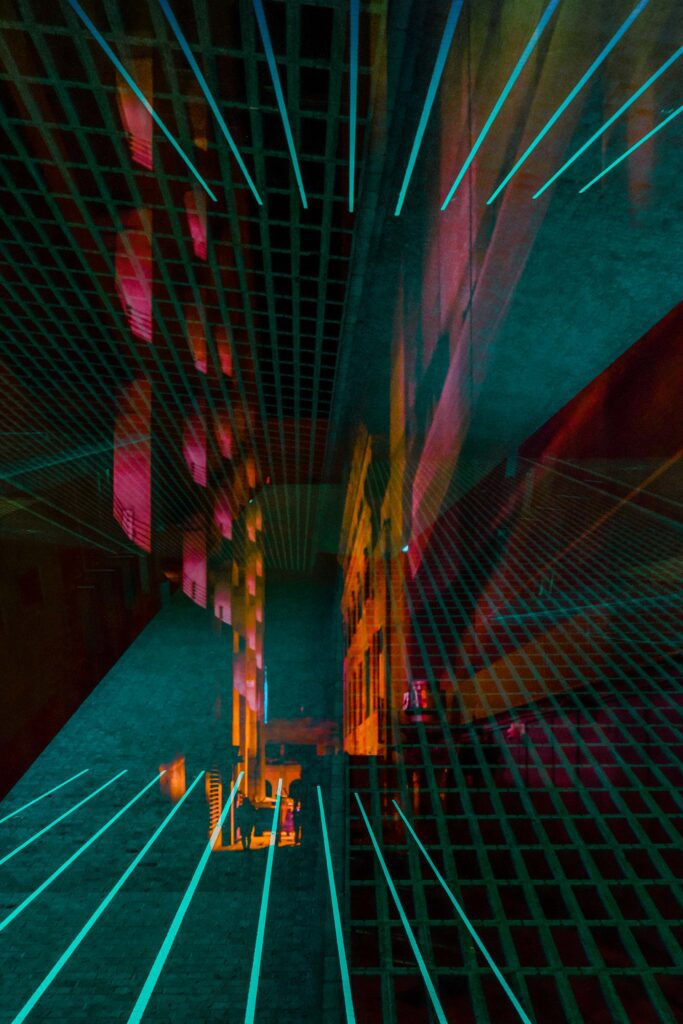
What I was really chasing with this camera had nothing to do with megapixels or burst rates. I wanted the Fujifilm film simulations – that legendary color science that makes straight-out-of-camera JPEGs look like they were processed by someone who actually has taste. The X-T5 delivers 20 film simulation modes including Provia, Velvia, Classic Chrome, Eterna, and the gloriously moody Acros for black and white work. What makes the system genuinely special is the ability to build and save your own custom recipes – adjusting grain, color chrome, highlight and shadow tones, sharpness and more until you’ve essentially built your own personal film stock. I took the camera to the streets of Dallas at night to test exactly this – shooting with multiple exposure mode, swapping between simulations, and throwing FX prisms in front of the lens to bend and scatter the city lights into something that felt less like documentation and more like painting. The results were, frankly, more fun than anything I’ve shot in years.
On the technical side, because you deserve more than my nocturnal adventures: the X-T5 is built around a 40.2 megapixel X-Trans CMOS 5 HR sensor paired with Fujifilm’s X-Processor 5. That is a serious amount of resolution stuffed into an APS-C body that weighs around 557 grams with battery and card – noticeably lighter than its predecessor the X-T4 (so I heard, never owned one). The 5-axis in-body image stabilization provides up to 7 stops of compensation (from Fuji), which can be among the best of any current Fujifilm body and is genuinely impressive for handheld low-light shooting (tested briefly). The OLED viewfinder offers 3.69 million dots at 0.8x magnification (from Fuji), the tilting rear screen is designed with stills photographers firmly in mind – it tilts vertically and sideways rather than fully articulating, which Fujifilm clearly considers a feature rather than a limitation. The autofocus system is a meaningful improvement over the X-T4 (everyone who upgraded talks about this), with subject detection covering humans, animals, birds, vehicles and more. Is it Sony-level? No (I never owned a Sony system, not yet at least, but used few when in company of Sony users). Is it good enough that you’ll rarely want to throw the camera across the room? Yes, with the right lenses – Fujifilm’s Linear Motor lenses in particular bring out the best in the AF system. The camera shoots up to 15 frames per second mechanically (from Fuji, I am not a burst shooter or a sport photographer), records up to 6.2K video (I am barely dipping my toes into this), and offers twin UHS-II SD card slots for backup peace of mind.
Now for the honest bit – because every camera has its compromises and anyone telling you otherwise is either paid by the manufacturer or dangerously delusional. The buffer is the X-T5’s most significant limitation. Shoot a rapid burst or even a recipe with some complicated settings and you will find yourself staring at the processing indicator more often than you’d like, especially with uncompressed RAW files. For sports or fast action, this camera will frustrate you – the X-H2S with its stacked sensor is the right tool for that job (or so I’ve been told, but I did not like the articulating screen on it), not this one. The build quality, while perfectly fine, feels a notch less premium (I own many Leica cameras) – the top dials have a slightly more plastic quality to them. There is also no headphone jack and no full-size HDMI port, which will annoy dedicated video shooters though for still work neither is a meaningful concern. And then there is the video-autofocus situation – firmware updates have been a somewhat bumpy road for AF in video mode, and while photo autofocus is reliable, video hunting remains an issue (I am not an expert in videography, but as I said, I want to experiment in that field, especially since social media platforms favor video now, I struggled with focus while making videos).
But here’s where I land after taking this camera through the streets of Dallas at night, chasing lights and shadows and playing with every creative tool it offers: the X-T5 is not trying to be a Swiss Army knife. It is trying to be a camera. A real, physical, tactile camera with dedicated dials for shutter speed, ISO and exposure compensation, a sensor that renders color in a way that borders on unfair to every phone in existence, and a creative ecosystem – the simulations, the recipes, the multiple exposure mode – that rewards photographers who actually want to think about what they’re making. If you are a professional wedding or portrait photographer looking for reliability and high resolution in a compact body, this is a genuinely excellent tool. If you are, like me in this particular scenario, a photographer who just wants to wander the city at night with prisms and light and no agenda whatsoever – this camera will make you feel like photography is fun again. Which, if I’m being honest, was exactly the point.
William Bichara is a Dallas-based award-winning wedding and lifestyle photographer with over 15 years of professional experience. Featured in Vogue, Junebug Weddings, D Magazine, Patron, Paper City and The Knot Hall of Fame. Available for weddings, portraits, corporate and destination photography worldwide.



Written by William Bichara – Dallas Photographer